Originally submitted as
assessment material for the module:
Machine Learning and
Predictive Analytics
Problem
Identification
The problem
to investigate is email spam filtering and the adaptability of a Machine
Learning (ML) algorithm to correctly classify spam emails. Spam detection is
critical to organisations and users across the globe, helping to improve
cybersecurity and assist fraud prevention. In 2023 alone, an estimated 45.6% of
all emails sent globally were identified as spam (Statista, 2024). Filtering
spam from inboxes using ML is a perfect example of bringing theory into
practice in the real-world.
In
this paper, spam emails will refer to malicious emails (e.g. phishing) or other
unsolicited email whose arrival in an inbox is likely to cause annoyance to a
user. I set out to build a predictive model which can classify emails using
frequency-based features, specifically experimenting with language-agnostic
features.
Dataset
Description and Analysis
This
analysis uses the Spambase dataset, originally released in 1999 by
Hopkins et al. It contains 4,601 instances with 57 features (Hopkins et al.,
1999). To create the dataset, researchers collected spam emails provided by
their internal postmaster at Hewlett-Packard Labs and other individuals, along
with non-spam emails collected from personal emails. The dataset features were
generated by exploring the frequency that terms appeared in an email. They also
created features which measured the run-length of sequences of consecutive
capital letters.
The
dataset was compiled in 1999. As a result, spam habits and emails are likely to
have changed in the decades since. This is known as Concept Drift, which
Singhal et al. (2020) described as a scenario “…where the relation between the
input data and the target variable changes over time…”. Whilst time has passed,
I feel that the variety of features and number of instances available lend well
to a simple language-agnostic experiment to detect spam.
After
the dataset was imported, checks were performed for missing values. An
additional check was conducted for any duplicate instances (emails). This would
be possible since the authors noted the emails were sourced “…from our
postmaster and individuals who had filed spam.” (Hopkins et al., 1999) and as
such there could be overlap. This check resulted in the removal of 391
instances (emails) where a copy was already present, leaving 4,210 instances
remaining. Duplicates were removed to prevent data leakage between training and
testing sets.
A
multivariate analysis will be conducted. This is justified since the dataset
has multiple features available for analysis such as dollar signs, exclamation
marks, and numbers.
Of the
57 available features I have selected the only 12 features which are numbers or
symbols, as these fit my approach of being language agnostic. I rejected the
feature word_freq_3d as this is mixed. Spam emails often rely on
exaggerated visuals, such as the overuse of dollar signs or large monetary
amounts. This approach is grounded in research. In a 2024 article, Longtchi et
al. found a direct correlation between Attention Grabbing techniques (bold
fonts, uppercase letters, highlighted text) and Visual Deception (replacing
“vv” with “w”) in malicious emails (Longtchi et al., 2024).
The 12
features are listed in Table A, including examples of the first and last
instances, along with the Target, Class.
|
Instance # |
#0 |
#1 |
#2 |
#3 |
#4 |
#4205 |
#4206 |
#4207 |
#4208 |
#4209 |
|
word_freq_000 |
0 |
0.43 |
1.16 |
0 |
0 |
0 |
0 |
0 |
0 |
0 |
|
word_freq_650 |
0 |
0 |
0 |
0 |
0 |
0 |
0 |
0 |
0 |
0 |
|
word_freq_857 |
0 |
0 |
0 |
0 |
0 |
0 |
0 |
0 |
0 |
0 |
|
word_freq_415 |
0 |
0 |
0 |
0 |
0 |
0 |
0 |
0 |
0 |
0 |
|
word_freq_85 |
0 |
0 |
0 |
0 |
0 |
0 |
0 |
0 |
0 |
0 |
|
word_freq_1999 |
0 |
0.07 |
0 |
0 |
0 |
0 |
0 |
0 |
0 |
0 |
|
char_freq_; |
0 |
0 |
0.01 |
0 |
0 |
0 |
0 |
0.102 |
0 |
0 |
|
char_freq_( |
0 |
0.132 |
0.143 |
0.137 |
0.135 |
0.232 |
0 |
0.718 |
0.057 |
0 |
|
char_freq_[ |
0 |
0 |
0 |
0 |
0 |
0 |
0 |
0 |
0 |
0 |
|
char_freq_! |
0.778 |
0.372 |
0.276 |
0.137 |
0.135 |
0 |
0.353 |
0 |
0 |
0.125 |
|
char_freq_$ |
0 |
0.18 |
0.184 |
0 |
0 |
0 |
0 |
0 |
0 |
0 |
|
char_freq_# |
0 |
0.048 |
0.01 |
0 |
0 |
0 |
0 |
0 |
0 |
0 |
|
Class |
1 |
1 |
1 |
1 |
1 |
0 |
0 |
0 |
0 |
0 |
|
Table A:
Selected Features, showing the first and last instances in Spambase. |
||||||||||
Algorithm
Selection
The primary
choice of algorithm for this task is LR. As a form of supervised learning, LR
can be trained with past examples of spam, enabling classification of unseen
examples. Pal (2021) writes in Cancer Research, Statistics, and Treatment
(CRST) of how multivariate LR is a widely accepted form of ML for cancer
diagnosis, which uses the past experience of patients
to estimate an outcome by modelling previous data. Whilst this dataset is not
predicting the outcome of cancer, it is following the same multivariate
approach to create a binary classification (spam/not spam).
As
well as classification, probabilities can be produced by LR, enabling custom
thresholds to be set if required, as well as providing confidence levels e.g.
“a 90% chance this email is spam”. LR is computationally efficient compared to
other models, with a fast training and prediction speed, it also provides the
ability to understand which features are having the most effect on predictions.
There are risks of course, such as overfitting, or non-linearity within
features. However, the input features are all numerical with linear
relationships between them. For example, the frequency of the dollar sign
appearing in an email, and whether it was classed as spam.
The
model was implemented using Scikit-learn (Pedregosa et al., 2011). Prior to
fitting the model, a Train/Test/Split was performed with 80% training, 20%
testing, giving 3,368 and 842, respectively. The LR model was implemented using
Scikit-learn’s LogisticRegressionCV function. This essentially allowed
for various configurations to be tested, with the best model automatically
selected. Features were scaled and a selection of regularisation values were
provided. Cross-validation was set to five, to aid with the selection of the
best model. The best model produced an accuracy score of 81.7%.
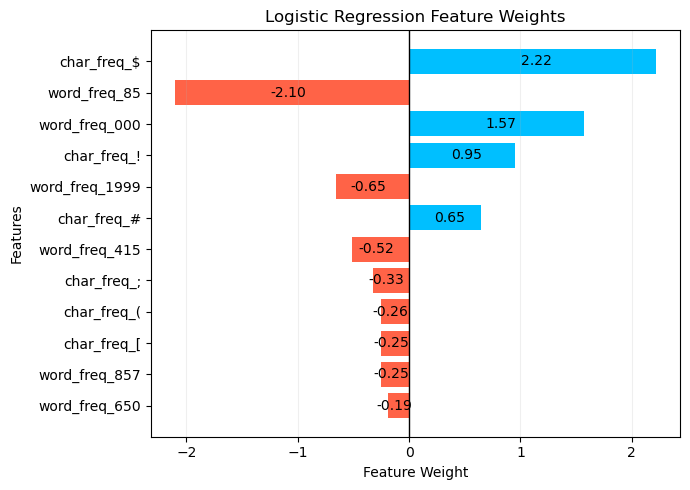
An
advantage of LR as previously mentioned, is the high interpretability of the
model. Feature coefficients, or weights, can be examined to determine which had
more impact. Figure 1 shows the outcome of the 12 features. As might be
expected, an email was more likely to be marked spam if it had a high use of
dollar signs, multiple zeros, and exclamation marks.
|
|
|
Figure 1:
Feature weighting from the Logistic Regression model. |
Evaluation
Various
metrics are available to interpret the performance of the model. As Bonaccorso
notes (2018, p.184), “The performances of all classifiers must be measured
using different approaches…” and as such we will consider a Receiver Operating
Characteristic (ROC) plot, a Confusion Matrix, and Classification Metrics. For
the purposes of this implementation the default classification score of 50%
will remain, this is an experimental implementation based on language agnostic
features. The default scoring will also enable easy comparison to an
alternative model.
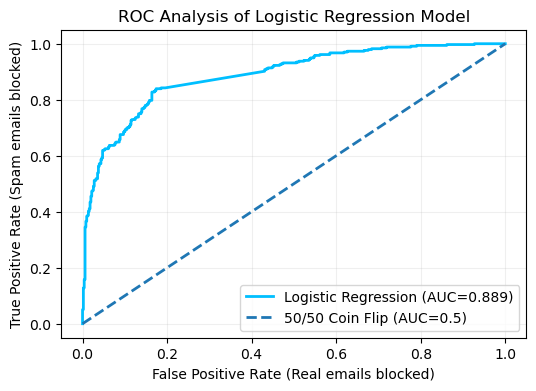
Initially
let us explore a ROC plot shown in Figure 2. Broadly, the graph appears to be
performing well, with an Area Under the Curve (AUC) score of 0.889
(3.d.p). AUC scores range from 0.5 (no
better than a coin flip) to 1.0 (a perfect score) and each graph should be
taken in context to its application. Indeed, a study published in 2022 in The
Lancet, considered AUC scores published in COVID-19 research material. Our
score of 0.889 could have been graded anywhere from Fair to Excellent depending
on institution (de Hond et al., 2022).
|
|
|
Figure 2: ROC
Plot of the Logistic Regression model, with added 50/50 comparison. |
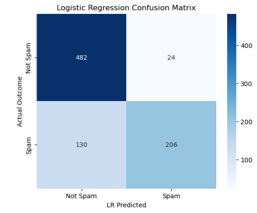
We can
next visualise the model’s performance by implementing a Confusion Matrix,
shown in Figure 3. Within our total test set of 842, the model correctly
identified 206 and 482 emails as spam and not spam, respectively. There were
130 (15.4%) instances where spam emails evaded the model. 24 Emails (2.9%) were
false positives and had this been a real email filter, may have been
automatically deleted or moved to a spam folder. Considering that this is based
only on the frequency of numbers and symbols, these are promising results.
|
|
|
Figure 3:
Confusion Matrix breaking down the model’s performance over the test set. |
Finally,
we can consider performance metrics such as precision and recall. Table 2 shows
the classification results over the test set of 842. Whilst the model had a
high precision and was very accurate when it did detect spam (89.6%), it only
managed to correctly locate 61.3% of spam instances. This is in line with the
Confusion Matrix metrics of 130 false negatives. When predicting not spam it
clearly performed better, isolating 95.3% of all instances, although its
confidence had a lower precision at 78.8%, in line with the 24 false positives.
|
|
|
Precision |
Recall |
F1 |
|
|
|
Not Spam |
78.8% |
95.3% |
86.2% |
|
|
|
Spam |
89.6% |
61.3% |
72.8% |
|
|
|
Table 2:
Classification results for Logistic Regression over the test set. |
|
|||
Overall,
the LR model has fared well with only 12 features.
Comparative
Analysis
An alternative
model for classifying spam could be k-Nearest Neighbours (kNN), another form of
supervised learning. A kNN model was implemented as a comparative exercise
against LR. The same Train/Test/Split methodology was implemented with a common
random variable ensuring the same training and test sets. Scikit-learn’s GridSearchCV
capability was employed with an initial k-value as the square root of the
training set, which was expanded either side to allow a range of values to be
tested. Features were scaled with StandardScaler(),
to help prevent higher values from skewing the distance calculations. The same
scaler was used with the LR model. The grid search also tested Euclidean and
Manhattan distances, cross-validation was set to five sets, as with LR.
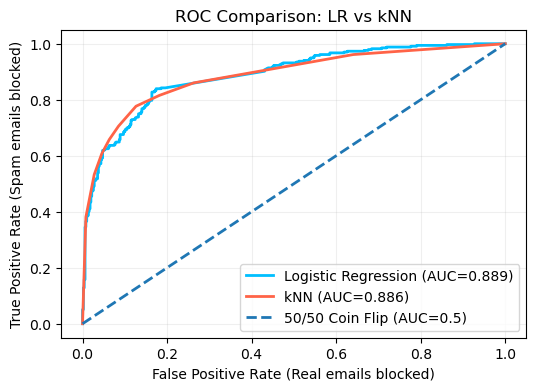
In
comparison to LR, the kNN model achieved an accuracy score of 83.1%. A subtle
improvement of 1.4% over LR. Although when calculating the AUC score, there was
a slight decrease in score by 0.003, at 0.886. This is illustrated in Figure 4
which shows an ROC comparison between the two models, where LR comes out ahead.
|
|
|
Figure 4: ROC
comparison between the Logistic Regression and kNN models. |
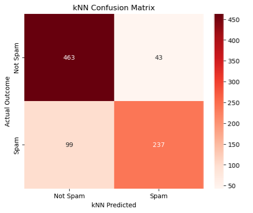
Figure
5 illustrates the kNN confusion matrix performance. The kNN model has managed
to increase the true-positive spam detection whilst also reducing the number of
false negatives. However, the false positive category has a notable increase to
43, whereas LR only marked 24 false positives. In the context of a spam filter
where emails may be deleted or filtered from mailboxes, this is a notable
decrease in performance.
|
|
|
Figure 5:
Confusion Matrix showing the performance of kNN over the test set. |
We can
compare the classification metrics for both models
side-by-side. Table 3 shows the consolidated F1 scores are higher for kNN which
on paper would normally suggest a better performance, given also that the kNN
model located 70.5% of the spam emails. However, as shown with the confusion
matrix there was a noticeable drop in performance with real emails being
misclassified as spam. On balance, a user is more likely to accept seeing the
occasional spam email, than have their real mail hidden or deleted.
|
|
|
|
Precision |
Recall |
F1 |
|
|
|
Not Spam |
LR |
78.8% |
95.3% |
86.2% |
|
|
|
kNN |
82.4% |
91.5% |
86.7% |
|
|
|
|
Spam |
LR |
89.6% |
61.3% |
72.8% |
|
|
|
kNN |
84.6% |
70.5% |
76.9% |
|
|
|
Table 3: Classification
comparison between Logistic Regression and kNN over the test set. |
||||||
As a
lazy-learning methodology, kNN models can accept multiple features such as those
present in the current dataset, and whilst a kNN model can be trained and
deployed to detect spam email it does have some distinct disadvantages over LR.
These include a lower interpretability at a feature level; it is difficult to
determine which features are having the most influence over the model. There is
also the computational cost to consider. Cunningham and Delany (2022) explained
that since all the work is done at runtime, a kNN model can have poor runtime
performance if a large training set is used. This is important considering that
a spam filter may have to consider millions of emails at any given moment.
Based
on the results of the two models and a comparison of strengths and limitations,
kNN can be rejected as a primary choice for classifying spam emails. Whilst it
has some potential, the inability to examine which features are having the most
impact, alongside the lower prediction speed, make kNN unsuitable at scale.
Conclusion
An LR
model based solely on features containing numbers or symbols, has at least some
real-world potential and could be explored further at scale. The implementation
of the model allowed 95.3% of real emails through its filter, although with a
disappointing catchment of only 61.3% of spam. However, this is before any
advanced feature engineering and adjustments to coefficients. A comparative
implementation of a kNN model only allowed 91.5% of real emails through.
This
is not to say that LR is the very best approach. Recently in an experiment by Zavrak and Yilmaz (2023), analysing the performance of
Convolutional Neural Networks (CNN) for spam detection, a CNN approach
outperformed existing ML models in several areas. Ultimately, on the balance of
accuracy, interpretability, and computational cost, an LR model would be
suitable for a real-world implementation of a language agnostic spam-filter.
Word count
(excluding references): 2,176
Bibliography
Bonaccorso,
G. (2018) Machine learning algorithms: popular algorithms for data science
and machine learning. Second edition. Birmingham; Packt
Publishing.
Cunningham,
P., Delany, S. J. (2022) k-Nearest Neighbour Classifiers - A Tutorial. ACM
computing surveys [online] 54(6), pp. 1 [Accessed 18 January 2026]
de Hond,
Anne A H et al. (2022) Interpreting area under the receiver operating
characteristic curve. The Lancet Digital Health [online] 4(12), pp.
853-855. [Accessed 15 January 2026]
Hopkins,
M., Reeber, E., Forman, G., Suermondt, J. (1999). Spambase, UCI Machine
Learning Repository [online]. Available from:
http://archive.ics.uci.edu/dataset/94/spambase [Accessed 11 January 2026]
Longtchi,
T. et al. (2024) Quantifying Psychological Sophistication of Malicious Emails. IEEE
access. [Online] 12, pp. 187512-187535. [Accessed 17 January 2026]
Pal,
K. (2021) Logistic regression: A simple primer. Cancer Research, Statistics,
and Treatment [online]. 4(3), pp. 551-554. [Accessed 18 January 2026]
Pedregosa
et al. (2011) Scikit-learn: Machine Learning in Python. Journal of Machine
Learning Research [online]. JMLR 12, pp. 2825-2830. [Accessed 11 January
2026]
Singhal,
S., Chawla, U., Shorey, R., ed. (2020) Machine Learning & Concept Drift
based Approach for Malicious Website Detection, 2020 International
Conference on COMmunication Systems & NETworkS (COMSNETS), Bengaluru, India, 7-11
January 2020. IEEE [online]. Available from:
https://ieeexplore-ieee-org.uwe.idm.oclc.org/document/9027485 [Accessed 18
January 2026]
Statista
(2024) Global spam volume as percentage of total e-mail traffic from 2011 to
2023. Available from:
https://www.statista.com/statistics/420400/spam-email-traffic-share-annual/
[Accessed 14 January 2026]
Zavrak, S.,
Yilmaz, S. (2023) Email spam detection using hierarchical attention hybrid deep
learning method. Expert systems with applications [Online] 233(120977)
[Accessed 18 January 2026]